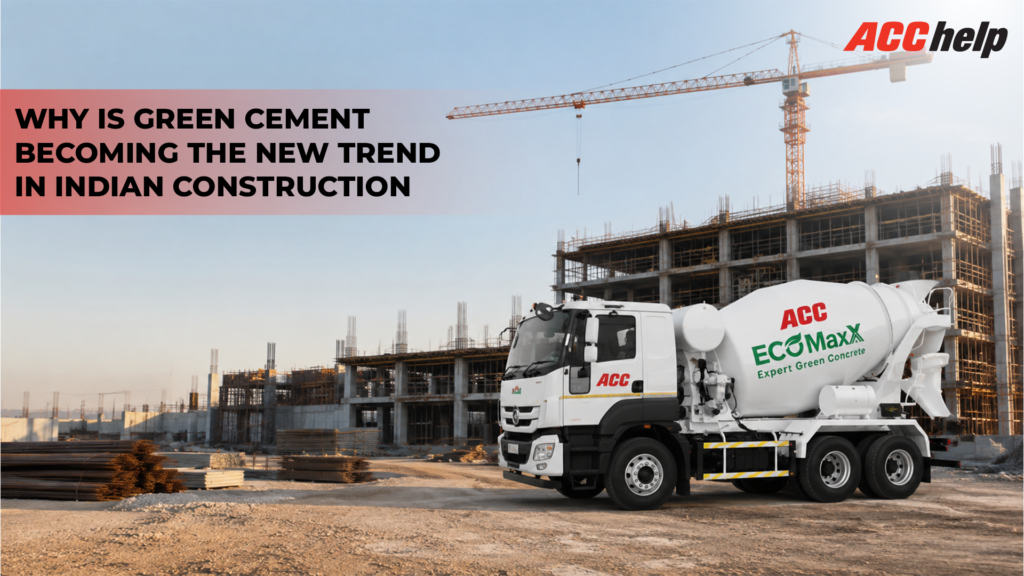
From the bustling corridors of Delhi to the rising tech hubs of Bengaluru, the rhythmic sound of construction is constant. However, as India builds at an unprecedented pace, a quiet revolution is taking place within the very bags of material arriving at the job sites.
The construction industry, long criticised for its heavy environmental footprint, is pivoting toward a more sustainable future. At the heart of this transformation is green cement, a material that is rapidly evolving from a niche alternative into the dominant trend for 2026 and beyond.
What Exactly is Green Cement?
To understand the trend, one must first understand the material. Green cement is not a singular product but a category of hydraulic binders manufactured through processes that significantly reduce the carbon footprint compared to traditional OPC.
Traditional cement manufacturing is one of the world’s leading sources of CO2. The process requires heating raw materials to nearly 1500°C, often using fossil fuels, and involves a chemical reaction that releases carbon as a byproduct.
Green cement breaks this cycle by:
- Optimising Raw Materials: Incorporating industrial by products like fly ash or slag to reduce the amount of limestone clinker needed.
- Lowering Thermal Energy: Utilising alternative fuels and more efficient kiln technologies to reduce the heat required for production.
- Carbon Capture: Integrating advanced technologies that capture emissions before they enter the atmosphere.
The Indian Construction Landscape in 2026
India is currently in a unique position where it must balance massive urban expansion with its international climate commitments. The green building movement has moved from luxury penthouses to affordable housing schemes.
Builders are realizing that sustainable materials offer more than just good PR. In many cases, green cement provides superior long term durability. It often features lower heat of hydration, which is a fancy way of saying it stays cooler while setting. In scorching Indian summers, this is a massive advantage, as it significantly reduces the risk of thermal cracks in large slabs and foundations.
Furthermore, the rise of specialized hubs, such as an Acc Green Building Centre, has made these materials accessible to the average person. These centers act as educational and distribution points, proving that sustainable building isn’t just for skyscrapers, it’s for the house next door.
Beyond the Environment: The Technical Superiority of Sustainable Binders
A common misconception is that eco-friendly means weaker. The reality of 2026 is quite the opposite. Modern green cement variants are often engineered to outperform their traditional counterparts in specific conditions.
Resistance to Chemical Attacks
In coastal regions like Mumbai or Chennai, salt laden air and groundwater can cause traditional concrete to spall or crumble over time as the internal steel reinforcement rust. Sustainable binders, particularly those containing slag, create a much denser microscopic structure. This density prevents harmful chlorides from reaching the steel, effectively doubling the lifespan of the structure.
Improved Workability
Masons and contractors often prefer working with eco-friendly blends because they tend to be smoother. The fine particles of fly ash act like tiny ball bearings in the mix, making the concrete easier to pump, pour, and finish. This leads to a better aesthetic finish on walls and ceilings reducing the need for thick layers of expensive putty or plaster later on.
Thermal Comfort
Buildings constructed with sustainable materials often exhibit better thermal insulation properties. In a country where air conditioning costs are a major household expense, a house that stays naturally cooler due to the density and composition of its concrete is a massive selling point.
What is the Role of Support Systems?
One of the biggest hurdles to any new technology is the knowledge gap. How does a local mason in a tier-2 city learn about the benefits of a low-carbon mix? This is where industry-led initiatives have changed the game.
By observing models like the ACC Green Building centre, we see a blueprint for how sustainability can be democratised. These centers provide:
- Technical Guidance: Helping small scale builders understand mix ratios and curing times.
- Product Diversity: Offering everything from sustainable blocks to specialised water shielding binders.
- Quality Assurance: Ensuring that the green label actually corresponds to high performance standards.
When a homeowner visits a facility like an ACC Green building Centre, they aren’t just buying materials, they are buying a specialised roadmap for their construction. This support system is a primary reason why the trend has moved so quickly into the mainstream.
Cost vs Value: The Economic Shift
For a long time, green was synonymous with expensive. However, the economy of scale has tipped the scales. As more plants switch to sustainable manufacturing, the price gap between traditional and green cement has narrowed significantly.
When you factor in the life cycle cost, the sustainable option is almost always cheaper. Consider the following:
- Reduced Repair Cost: Less cracking and better resistance mean you aren’t repainting or waterproofing your roof every three years.
- Material Efficiency: High performance eco-binders often allow for slightly leaner structural designs without sacrificing safety.
- Government Incentives: In many Indian states, buildings that meet certain green criteria are eligible for property tax rebates or faster permit approvals.
The Road Ahead: The Smart Choice for 2026
The transition to green cement in India is not a fad, it is a fundamental correction in how we interact with our environment. It represents a marriage between ancient building wisdom and futuristic chemical engineering.
By choosing these materials, you are guaranteeing that your home is stronger, cooler, and more durable. You are utilising the expertise found at hubs like an ACC Green Building Centre to make informed, data driven decisions.
Most importantly you are participating in a global movement to ensure that as India grows, it grows responsibly.