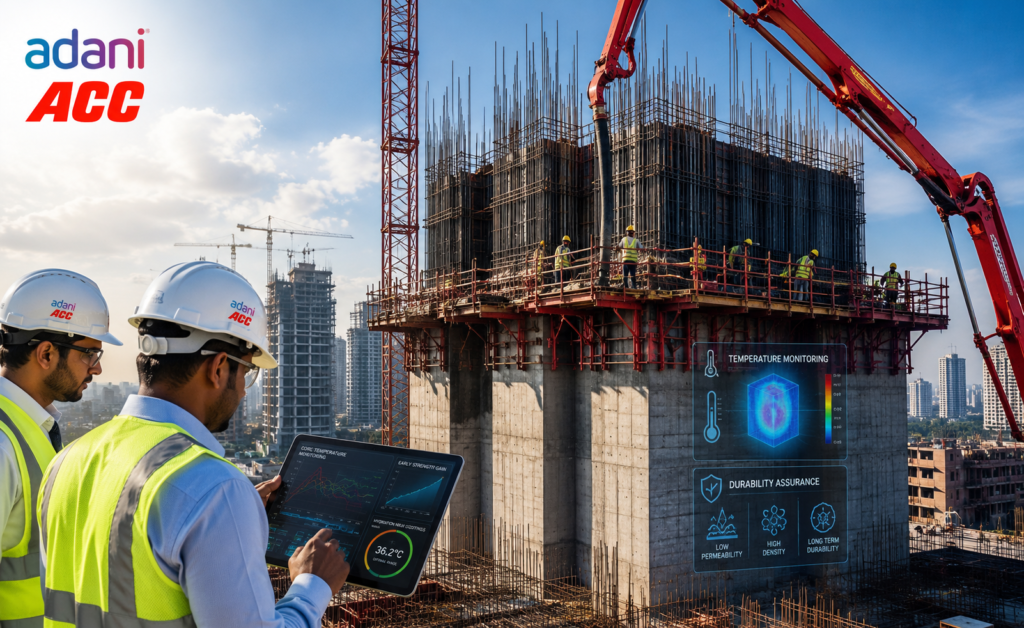
As Indian cities continue to grow vertically, high-rise buildings have become a defining feature of urban development. From commercial towers and mixed-use developments to premium residential skyscrapers, modern construction projects demand structural systems that can deliver exceptional strength, speed, and long-term durability.
At the center of every high-rise structure lies the reinforced concrete core—the vertical spine that provides stability against gravity loads, wind forces, and seismic activity. Constructing these cores efficiently requires concrete that develops strength rapidly while maintaining dimensional stability and durability throughout its service life.
This is where selecting the strongest cement in India becomes a critical engineering decision. However, strength alone is not enough. Structural engineers must also manage hydration heat, thermal cracking risks, workability requirements, and long-term durability objectives.
This article explores how high-performance cement contributes to successful high-rise core construction and the key factors engineers should evaluate when selecting cement for demanding structural applications.
Why High-Rise Core Structures Present Unique Challenges
Unlike conventional residential buildings, high-rise cores often involve:
- Large-volume concrete pours
- High-grade concrete mixes ranging from M40 to M80
- Dense reinforcement congestion
- Fast-track construction schedules
- Continuous vertical construction cycles
- Strict durability requirements
These conditions create competing performance demands.
Project teams want rapid early-age strength to accelerate formwork removal and floor cycle times. At the same time, excessive heat generation during cement hydration can lead to thermal gradients and cracking, which may compromise long-term durability.
Balancing these factors requires a cement solution specifically designed for high-performance structural applications.
Understanding Strength Beyond Compressive Test Result
When evaluating the strongest cement in India, many stakeholders focus only on compressive strength values. While compressive strength remains important, modern high-rise construction requires a broader performance perspective.
Structural engineers increasingly evaluate cement based on:
- Early-age strength development
- Consistency of performance
- Hydration characteristics
- Workability retention
- Compatibility with admixtures
- Durability performance
- Resistance to permeability and chloride ingress
A cement that delivers consistent performance across all these parameters often provides greater project value than one that merely achieves high laboratory strength numbers.
In high-rise construction, predictable performance is often more important than isolated peak strength results.
The Relationship Between Cement Strength and Construction Speed
Construction schedules for high-rise towers are heavily influenced by floor cycle times.
Developers and contractors aim to reduce the duration required for:
- Formwork stripping
- Core wall progression
- Vertical element casting
- Successive floor construction
High-performance cement contributes to faster construction by enabling:
Faster Early Strength Gain
Early-age strength development allows engineers to safely remove formwork sooner and proceed with subsequent construction activities.
When concrete reaches specified strength targets quickly, project teams can:
- Reduce construction delays
- Increase productivity
- Optimize resource utilization
- Accelerate project completion
Improved Structural Efficiency
High-strength cement supports the production of high-grade concrete mixes capable of meeting demanding structural design requirements.
This can lead to:
- Reduced member sizes
- Increased usable floor area
- Better load-bearing capacity
- Enhanced structural performance
These advantages are especially important in urban high-rise developments where space optimization is critical.
Managing Hydration Heat in High-Rise Core Construction
One of the most overlooked aspects of selecting the strongest cement in India is understanding hydration heat.
When cement reacts with water, it generates heat through a chemical process known as hydration. In large concrete sections such as core walls, shear walls, transfer slabs, and foundations, this heat can accumulate internally.
If the temperature difference between the concrete core and outer surface becomes excessive, thermal stresses may develop.
This can result in:
- Thermal cracking
- Reduced durability
- Increased permeability
- Long-term maintenance concerns
Why Hydration Heat Matters
High-rise core structures frequently involve thick concrete sections that behave similarly to mass concrete.
Examples include:
- Lift cores
- Shear walls
- Transfer structures
- Raft foundations
- Podium slabs
In such applications, engineers must carefully balance strength development with heat management.
Premium cement formulations help achieve this balance by optimizing clinker chemistry, fineness, and supplementary cementitious materials.
Achieving Early Strength Without Excessive Thermal Stress
A common misconception is that rapid strength gain always requires higher heat generation.
Modern cement technology demonstrates that strength development and thermal management can be optimized simultaneously.
Advanced cement formulations can provide:
- Consistent hydration behavior
- Controlled heat evolution
- Enhanced particle packing
- Improved microstructure formation
These characteristics enable concrete to develop strength efficiently while reducing the risk of thermal distress.
For large-scale high-rise projects, this translates into improved construction reliability and long-term structural integrity.
Importance of Water-Cement Ratio Control
Even the strongest cement in India cannot deliver optimal results without proper mix design.
The water-cement ratio remains one of the most influential factors affecting concrete performance.
Lower water-cement ratios generally contribute to:
- Higher compressive strength
- Reduced permeability
- Improved durability
- Better resistance to aggressive environments
However, reducing water content can negatively impact workability.
This is why modern high-rise projects increasingly rely on engineered concrete systems that combine premium cement with advanced admixtures to achieve both strength and workability.
Workability Retention for High-Rise Pumping Operations
Concrete placement in tall structures presents logistical challenges.
Pumping concrete hundreds of meters vertically requires:
- Stable rheology
- Consistent flowability
- Controlled segregation
- Adequate slump retention
Loss of workability during transportation or pumping can lead to:
- Placement difficulties
- Honeycombing
- Cold joints
- Surface defects
High-performance cement contributes to improved workability retention, enabling smoother pumping operations and more reliable placement in congested reinforcement zones.
This becomes particularly valuable in fast-track projects where concrete quality must remain consistent across multiple pours.
Durability: The True Measure of Structural Performance
While strength often dominates procurement discussions, durability ultimately determines the lifespan of a structure.
For high-rise buildings expected to perform for decades, durability considerations include:
Resistance to Chloride Penetration
Chloride ingress can initiate reinforcement corrosion, compromising structural integrity over time.
Dense concrete matrices produced using premium cement help reduce permeability and protect embedded steel.
Reduced Shrinkage Cracking
Excessive shrinkage can create pathways for moisture and aggressive chemicals.
Optimized cement systems support dimensional stability and crack resistance.
Enhanced Sulphate Resistance
In challenging environmental conditions, durable cement formulations improve resistance to chemical attack and deterioration.
Lower Permeability
Reduced permeability improves overall durability by limiting water penetration and protecting reinforcement from corrosion-related damage.
These attributes make durability a key criterion when evaluating the strongest cement solutions for modern infrastructure and high-rise projects.
Selecting the Strongest Cement in India: Key Evaluation Criteria
Structural engineers should consider multiple factors before finalizing a cement solution.
Strength Consistency
Consistent strength development is often more valuable than occasional peak performance.
Quality Control Standards
Manufacturing consistency plays a critical role in ensuring predictable concrete behavior.
Compatibility with Admixtures
Modern high-performance concrete relies heavily on chemical admixtures. Cement should perform reliably with contemporary admixture systems.
Durability Performance
Long-term resistance to environmental exposure should be evaluated alongside compressive strength.
Technical Support
Access to concrete technology expertise can significantly improve project outcomes during mix design, trial batching, and execution phases.
How Premium Cement Supports Sustainable High-Rise Construction
Sustainability has become a major consideration in contemporary construction.
High-performance cement contributes to sustainability goals by enabling:
- Longer service life
- Reduced repair requirements
- Improved resource efficiency
- Optimized material consumption
- Enhanced structural durability
When buildings remain functional and durable for longer periods, their overall environmental impact decreases.
As a result, project teams increasingly evaluate cement not only based on strength but also on lifecycle performance.
Conclusion
The search for the strongest cement in India should extend beyond compressive strength values alone. In high-rise core structures, engineers must simultaneously manage hydration heat, early-age strength development, workability retention, durability, and construction efficiency.
Premium cement like ACC Limited that deliver balanced performance across these parameters help reduce execution risks while supporting faster construction cycles and long-term structural reliability.
For modern high-rise developments, the ideal cement is not simply the one that achieves the highest laboratory strength-it is the one that consistently delivers predictable performance, supports efficient project execution, and contributes to durable structures capable of serving generations.
As India’s skyline continues to evolve, selecting the right high-performance cement will remain a critical factor in building stronger, safer, and more resilient structures.